

From Blue Devils to Judges: A Story from the QHS Class of ’71
Judge William “Bill” Mays, Judge Thomas “Tom” Ortbal, and Judge Scott Walden Class of 1971
By: Katie Rodemich ’02, Freelance Writer
In a quiet historic neighborhood of Quincy where porches still invite conversation and neighbors keep a watchful eye on one another’s homes; three retired judges sit together recalling the unlikely symmetry of their lives. The street itself feels like a character in the story—lined with old trees, brick sidewalks, and houses that have seen generations come and go.
Judge Bill Mays, Judge Tom Ortbal, and Judge Scott Walden —Quincy High School Class of 1971—graduated in the same class, pursued careers in law, and later found themselves not only colleagues on the bench, but neighbors. What are the odds that one high school class would produce three judges, let alone that life would lead them back to living in the same neighborhood? The trio themselves often marvel at the coincidence. Their story, marked by friendship, fate, and a deep love for community, is a testament to the enduring bonds formed in Quincy, even with the unpredictable journeys that followed.

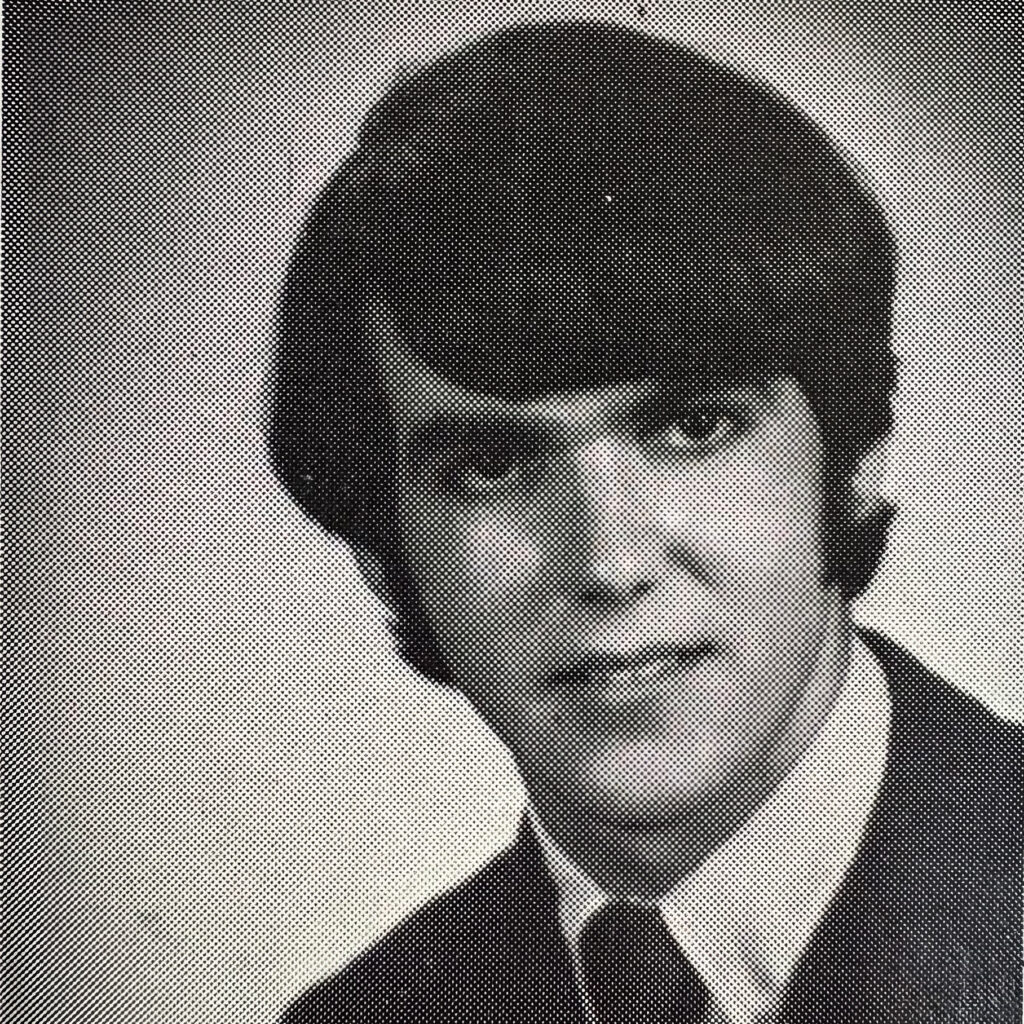
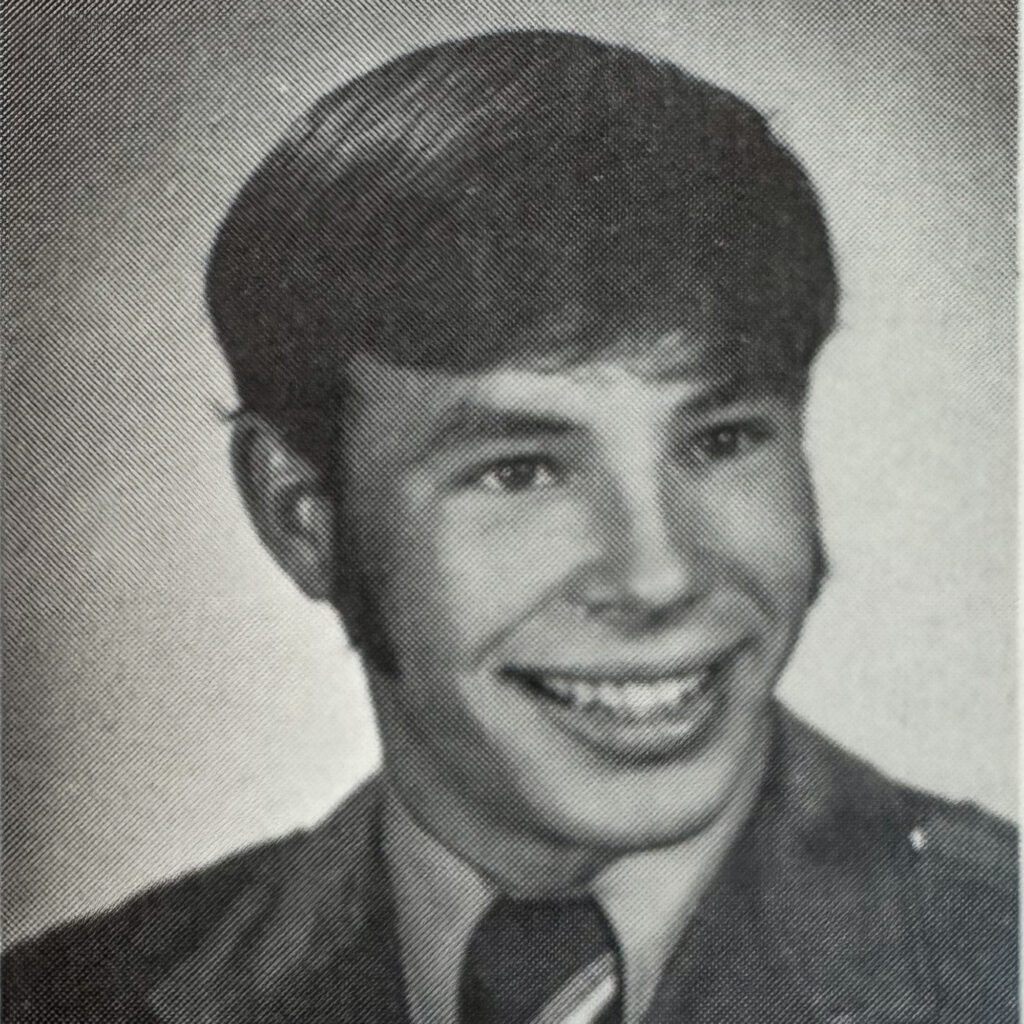
In 1971, the three crossed the commencement stage as proud QHS Blue Devils. Their paths through high school, however, were not identical.
“I’m probably the outlier here, because I only had one year at QHS,” Ortbal admits, having transferred from Christian Brothers his senior year. “It was voluntary—I wasn’t expelled!” he adds quickly, drawing laughter from the group. “We like to spread that rumor, but it’s not true,” Mays and Walden teased.
Ortbal talks about arriving at QHS with the perspective of someone stepping into a story already in motion. The friendships were formed and the rhythms of senior year were already in place. “My experience at QHS was kind of limited,” he says. “I didn’t have a clique. I didn’t have a specific group.” Yet within that short window, life shifted in a way he never expected. “The highlight was I met my future wife, Kai,” he shares. “We probably would not have met if I had not transferred.” He adds with a proud smile, “We are celebrating 53 years of marriage.”
He reflects on the winding path that led him there. “My family moved to Quincy when I was in fifth grade. I started at Monroe School…Quincy Junior High, two years, three years at Christian Brothers, and then graduated from Quincy High.”
Mays reflects on just how far back his connection with Walden goes. “Scott and I have a longer relationship.”
“I was a year old when we moved to Quincy,” Walden adds. “I don’t remember exactly when, but our dads—Robert and Owen—became law partners. We would have moved here in ’54, so that partnership probably started no later than ’56.”
Mays and Walden often tell one of their favorite stories about how that partnership came to be. Before the merger, their fathers were practicing at separate firms. Walden’s dad had joined Bob Hunter’s practice, but when Hunter became a judge, it prompted his dad to consider the next chapter. Mays’s father, meanwhile, had spent the early years of his career working with longtime Quincy attorney Chauncey Wood until Wood’s passing in 1954. When the timing aligned, the two men decided to join forces.
It was the beginning of a partnership that would define a generation of local legal practice—and to this day, the name “Walden & Mays” still echoes through Quincy’s legal history.
Mays and Walden’s friendship trace back to the simplest places—quiet neighborhood streets and the daily walk to school. Their homes wereseparated by only a few blocks. That proximity naturally wove their childhoods together. They grew up moving through Adams School together—often arriving side by side—and carried that connection into junior high and then high school.
Their families were just as intertwined. They recall how their fathers shared a car to work, spending so much time together that the boys were often driven to junior high by the pair. Every Friday afternoon, their parents played golf, and their moms would pick them up from Adams School and take them out to Spring Lake. That weekly ritual became a backdrop of their childhood—Mays and Walden dropped off at Spring Lake after school while the adults headed to the course, the boys passing the time playing golf, swimming, or exploring the creek.
In high school, Mays and Walden both broadened their world through the American Field Service program. In Walden’s junior year, his family hosted a senior from Barcelona, Pedro Auzmendi, and the families grew so close that Scott later traveled with his parents to Spain to visit them. Mays exchange experience took him to Trujillo, Peru, where he spent one summer living with a local family and immersing himself in daily life.
Although all three graduated in the same class, their lives initially moved in different directions. They didn’t truly reconnect until years later, as young lawyers navigating the early stages of their careers in Chicago. Mays remembers spotting Judge in a bar review course—recognizing a familiar Quincy face in a crowded lecture hall. Walden’s first Chicago memory of Ortbal is just as vivid: stepping into an elevator at John Marshall Law School, where they were both students, and realizing their paths had crossed again.
Ortbal likes to joke that, somewhere along the way, the other two “adopted” him into the fold—a line that always gets a laugh from Mays and Walden because of how naturally their friendship formed. “We went to high school together and graduated the same year. Didn’t really know each other—but then we reconnected in Chicago, Illinois,” Ortbal explains.
As the conversation turns to their legal careers, the timeline continues to take shape.
Walden returned to Quincy in 1978 after completing his undergraduate degree at Principia College in 1975 and earning his J.D. from Valparaiso University in 1978. He stepped immediately into practice alongside his and Mays fathers. His career continued to grow from there. In 1995, he was appointed a circuit judge for the Eighth Judicial Circuit by the Illinois Supreme Court and was later elected to the bench, serving with distinction until his retirement in 2015.
Mays’s path was a little less linear but every bit as intentional. He graduated from Valparaiso University in 1975 with a degree in engineering and spent three years building cable television systems before realizing he didn’t want a career that would keep him on the move. He shifted course, earned his J.D. from Chicago’s John Marshall Law School in 1981, and returned to Quincy that same year ready to begin a new chapter. The pace was fast: he took the bar exam in February, got married in April, learned he’d passed just before the wedding, and even cut his Ozarks honeymoon short by a day to be sworn in Springfield. His legal career continued to build from there, eventually leading him to the judiciary when Mays began serving as a judge of the Eighth Judicial Circuit in 2004 and remained on the bench until his retirement in 2016.
With Mays newly returned and Walden already established in the family firm, their office held a rare symmetry—two father–son pairs practicing side by side before their paths began to branch in new directions.
Ortbal’s legal trajectory took shape around the same time. After earning his B.A. from Quincy College in 1975 and his J.D. from John Marshall Law School in 1978, he was admitted to the bar and began building a broad foundation in legal practice—including trust administration, banking law, real estate, and municipal work. His career ultimately led him to public service and then to the bench, where he served as an associate judge in the Illinois Eighth Judicial Circuit Court with reappointment terms through the early 2010s and serving until his retirement in 2014.
By 1988, the paths of all three men had converged in ways none of them could have predicted back in high school. Tom Leeper’s election in 1984 reshaped the local legal landscape, and Walden began serving part-time as a state’s attorney—stepping fully into the role four years later. That period was also when Walden and Ortbal truly came to know one another. Their work intersected frequently as Ortbal moved into the role of Assistant Corporation Counsel following a period as an assistant state’s attorney, giving Walden and Ortbal plenty of opportunities to cross paths.
Mays, meanwhile, was finding his footing across the hall. After returning to Quincy in 1981, he spent roughly three years in the Public Defender’s Office, putting him and Walden in the same building—but on opposite sides of the courtroom. He later joined Tony Cameron’s staff and remained there until Tony lost the 1984 election to Leeper, returning in 1985 as Assistant City Attorney and serving in that role for several years.
As the conversation shifted toward their years on the bench, a distinctive picture of Quincy’s judicial community began to emerge. The judicial landscape of Quincy makes their story even more remarkable. For a time, the county had seven judges—and four of them had grown up in the same era and lived within blocks of one another. Among them was Judge Mark Schuering, a 1971 graduate of Christian Brothers, who lived just down the street. His presence on the bench added yet another layer to the uncanny neighborhood cluster of judges serving at the same time.
Inside the courthouse, their days often ran in tandem. Mays and Walden shared the felony docket, their courtrooms—1B and 2B—side by side. They spent years walking the same hallways, trading files, comparing dockets, and settling into the everyday rhythm of courthouse life. They even joked about whose courtroom was better: Walden had the private bathroom; Mays had the better view—until the new jail blocked it.
Though their paths to the bench were different, the way they stepped away unfolded almost in unison. Orbal retired in 2014. Walden followed the next year. Mays finished his service in 2016. In reflecting on that chapter, all three admitted—jokingly, but with a touch of candor that the work was never quite as fun once the trio was no longer together.
Beyond courtrooms and offices, their personal lives overlapped as well. Ortbal returned to Quincy around the same time Walden and Mays did, and the three soon found themselves running into one another at community events or simply because they lived in the same part of town as young attorneys. As they began raising families and building their careers, those casual encounters gradually deepened into genuine friendship, drawing their circles closer over time.
Mays and his wife Sharon began their life back in Quincy in an upstairs apartment on North 18th owned by Ruth Baker—a space they truly cherished. She had the second floor of her house set up as an apartment, and it was a comfortable, well-suited place for them in those early years. But when Sharon became pregnant, Mrs. Baker gently pointed out the open stairway and explained that it wouldn’t be appropriate or safe for a child. Her honesty came with kindness, and the timing couldn’t have been better: a house in a familiar neighborhood came up for sale, and Bill and Sharon bought it, beginning a new chapter for their growing family.
Just as Mays had always felt a fondness for the neighborhood, Walden and his wife Robin were drawn to the same quiet streets and old homes that had long held a certain appeal. Walden had loved those east-end blocks since childhood — biking with Mays past the grand houses and exploring the neighborhood long before he ever imagined living there. That quiet charm stayed with him, drawing him back years later when it came time to choose a home. Mays echoed that sentiment, noting that the attraction never really faded; he still walks the neighborhood most mornings, often beginning his day with a cup of coffee on the front porch. From the start, the area felt rooted in history: tree-lined, steady, and full of the character that defines Quincy’s older districts.
Ortbal reflected on how his family found their home through a bit of serendipity, remembering Walden stepping in as an “unlicensed realtor” and guiding them toward a place just down the street. Don Hatch had asked Walden to help find a buyer, and Walden mentioned the house to Ortbal almost in passing. That small exchange set everything in motion, and the sale came together quickly. By 1987, all three men were neighbors in the area.
Their lives continued to weave together in the natural cadence of Quincy—golfing as a trio, serving in community organizations such as Gem City “Breakfast” Kiwanis, gathering at local events, and long-standing community traditions. Whenever the three couples go out to dinner, the pattern never changes: Mays, Walden, and Ortbal slip into stories, while their wives listen with amused familiarity. Some dynamics, they say, stay the same no matter how many years pass.
When the conversation turned to mentors and teachers, the men lit up with memories—moments from decades ago resurfacing as clearly as if they’d happened last week. These were the voices that shaped them long before their legal careers or their return to Quincy’s familiar circles.
Walden immediately thought of the teacher who sparked his love of history: “Mr. Walter Wagoner was a history teacher. He was my favorite high school teacher… I just had a fascination with history.”
Mays remembered the educators who truly made a lasting impression— “I enjoyed Mrs. Joyce McKinley for cultures and Mike Humphreys’ English class… my two favorite classes from that year.” His mind then went to two other English teachers who shaped him: Gail Sharkey and Dave Pritchett, the world-traveling educator who taught in Saudi Arabia and is now settled in Evanston. Mays continues to keep in touch with Pritchett today.
Mays also spoke warmly of Mr. Houston Kirk, his Algebra II teacher in junior year—an “excellent” teacher who made difficult concepts feel accessible. When Kirk retired, Mays continued with calculus and had Terry Mickle his senior year. Mickle would go on to become the principal of Washington Elementary School—a role the group agreed suited him well.
Ortbal shared his own formative memory of Mary Nell Meyer—who taught his eighth-grade English and history class in Quincy Junior High. “She brought me out of my shell,” he said. “I was a really shy kid, and she took note of me.”
When asked what advice they would give to younger generations, the three men offered their perspective. Their guidance comes from years of lived experience.
Walden reflected on how each stage of his education demanded more than he expected—working harder in college than in high school, and harder still in law school. He went straight through school and likes to joke that if someone had paid him to study, he’d still be doing it. Beneath the humor was a point about staying flexible. Early on, he imagined a career much like his father’s, working with real estate closings, tax work, and estate planning. But once he began trying cases as a young prosecutor, he immediately knew trial work was where he belonged. His takeaway was straightforward: work hard, stay open, and trust that the path you end up on may not be the one you first imagined.
May’s journey took its own direction—shaped by timing, detours, and a growing sense of the life he wanted to build. He began with an engineering degree but soon realized he wanted a path that would allow him to stay rooted in one place, which led him to law school. The break from academics served him well; when he returned, he carried a new level of focus and intention. Later, when he hoped to become a judge, the opportunity didn’t come as early as he expected. In hindsight, the delay became its own gift. The role arrived when he was truly ready for it. As he stated, “Some people will say that’s not being aggressive, and therefore a lot of things will pass you by. But that’s not the philosophy that I have.”
Ortbal added that none of them went into law expecting to become judges; instead, they were guided by simple principles—work hard, be conscientious, and treat people well. Those values shaped how he approached his courtroom, especially when people stood before him at some of the hardest moments of their lives. “You know, it’s also the cliché to use the golden rule,” he said, reflecting on how basic the idea seemed but how deeply it had grounded him over the years. He recalled the days when he was handling felony cases—individuals who had found themselves in difficult circumstances—and even then, he focused on finding the humanity in front of him. “I honestly—maybe to a fault—could always find some inkling of goodness in the person, the defendant, no matter what the crime was,” he said. That instinct—to look for the good—became a quiet through-line of his judicial philosophy.
Mays and Walden shared the sentiment; their careers had grown from the same roots of hard work, respect, and the belief that every person deserved to be treated with dignity. In their own courtrooms—especially in places like traffic court or small claims, where defendants often feel invisible—they made a point to speak to people rather than at them. It wasn’t always easy, but they believed it mattered.
Walden echoed that belief succinctly: “Everybody we encounter is one of God’s children… That doesn’t mean there’s not punishment for doing bad things, but that’s why you’re showing respect.” It was the clearest distillation of his approach—firm when it needed to be, compassionate always.
Their story stretches far beyond three classmates rising to serve on the bench. It shows how lives can run parallel for decades before finally converging. What began at Quincy High School evolved into shared courtrooms, shared service, and even porches in the same neighborhood. For more than fifty years, their paths kept bending back toward one another—anchored by family ties, deep roots, and the pull of home. It remains a remarkable convergence: one graduating class producing three judges who returned to Quincy, built their careers here, and became neighbors, colleagues, and lifelong friends.





NOMINATE A BLUE DEVIL
We want to hear from you! Visit bit.ly/QHS-Feature to nominate fellow Blue Devils you want featured in our upcoming newsletters!
READ MORE ALUMNI SPOTLIGHTS
To read more QHS Alumni Spotlights, visit qpsfoundation.org/alumni-spotlights.